
Is your productivity hampered by logistical bottlenecks that are eating into your margins? These bottlenecks can quickly turn a one-off overload into an operational crisis. This article explores their causes - lack of planning, obsolete systems, dependence on suppliers - and the methods for pinpointing them: flow mapping, key performance indicators (KPIs), tools such as WMS. You'll find concrete solutions for streamlining your processes, from automating critical tasks to intelligently reallocating resources, while avoiding the hidden costs of overstocking and waiting times. The aim: to transform your logistics flows in order to increase your reactivity, reduce stress and boost your competitiveness.
- The multifactorial causes of a bottleneck
- How can you detect a bottleneck in your processes?
- Strategies and solutions for solving a logistics bottleneck
- Anticipating to avoid suffering: towards resilient logistics
What is a logistics bottleneck?
Defining a congestion point in the supply chain
A logistical bottleneck is a critical stage in an industrial or logistical process where capacity falls short of demand, slowing down the entire flow.
Just as the neck of a bottle limits the flow of a liquid, such a blocking point delays production, generates intermediate stocks and lowers productivity.
It may concern a machine, an employee or a department operating at maximum capacity, unable to handle all assigned tasks.
This phenomenon often manifests itself after having already caused delays, with visible impacts on delivery times and operating costs.
Direct impact on company performance
An unresolved bottleneck causes production stoppages, costly overstocking and growing customer dissatisfaction.
The consequences extend to the entire supply chain: additional storage costs, loss of competitiveness, premature wear and tear on equipment, and a drop in team morale.
For an international company like SXE Consulting specializing in industrial performance, identifying these friction points is a strategic priority in order to optimize your supply chain and maintain its responsiveness.
Recent disruptions such as the pandemic and the blocking of the Suez Canal have demonstrated the vulnerability of logistics systems to these constraints, reinforcing their ability to adapt to new situations. the challenge of proactively resolving them.
The multifactorial causes of a bottleneck
Human and organizational origins
Human error and poor organization are among the major causes. 57 % of companies suffer from delays due to poor inter-departmental coordination. Lack of planning or unclear responsibilities lead to duplication of work. Overloaded teams or inadequate skills add to these problems, as in the case of a German factory where confusion between departments caused a 12-hour shutdown.
Material and technological failures
Obsolete tools aggravate blockages. 43 % of warehouses with manual management suffer from traceability errors. Outdated software or poorly maintained machines generate an additional 20 % of delays. Lack of automation slows down responsiveness, like a distribution giant in 2022 with an inefficient fleet system.
External factors: dependence on suppliers and transport
Global supply chains expose you to the unexpected. Raw material delays due to single suppliers affect 1 in 3 companies. Dock saturation, with 8 hours lost per truck in European ports, underlines the limitations of infrastructures. Lack of interoperability between tools exacerbates bottlenecks.
- Lack of organization and planning Unclear processes generate downtime.
- Obsolete systems and software Outdated technology slows down operations.
- Internal communication problems Disorganization between sales, production and logistics.
- Excessive dependence on suppliers A single delay paralyzes the entire chain.
- Manual flow management Non-automated, error-prone tasks.
How can you detect a bottleneck in your processes?
Flow analysis and visualization methods
For identify a bottleneck, Value Stream Mapping (VSM) is essential. It allows you to visualize the entire process, revealing the stages where stocks or tasks accumulate. Kanban boards, by organizing tasks in columns (to do, in progress, completed), instantly show where congestion is occurring. Direct observation on the ground (Gemba walk) completes this approach by pinpointing physical queues or repeated delays.
For a detailed method, identify a production bottleneck requires a combination of these techniques. These traditional tools remain effective for diagnosing visible blockages, but need to be coupled with in-depth data analysis for hidden causes.
Data analysis: the power of KPIs and software
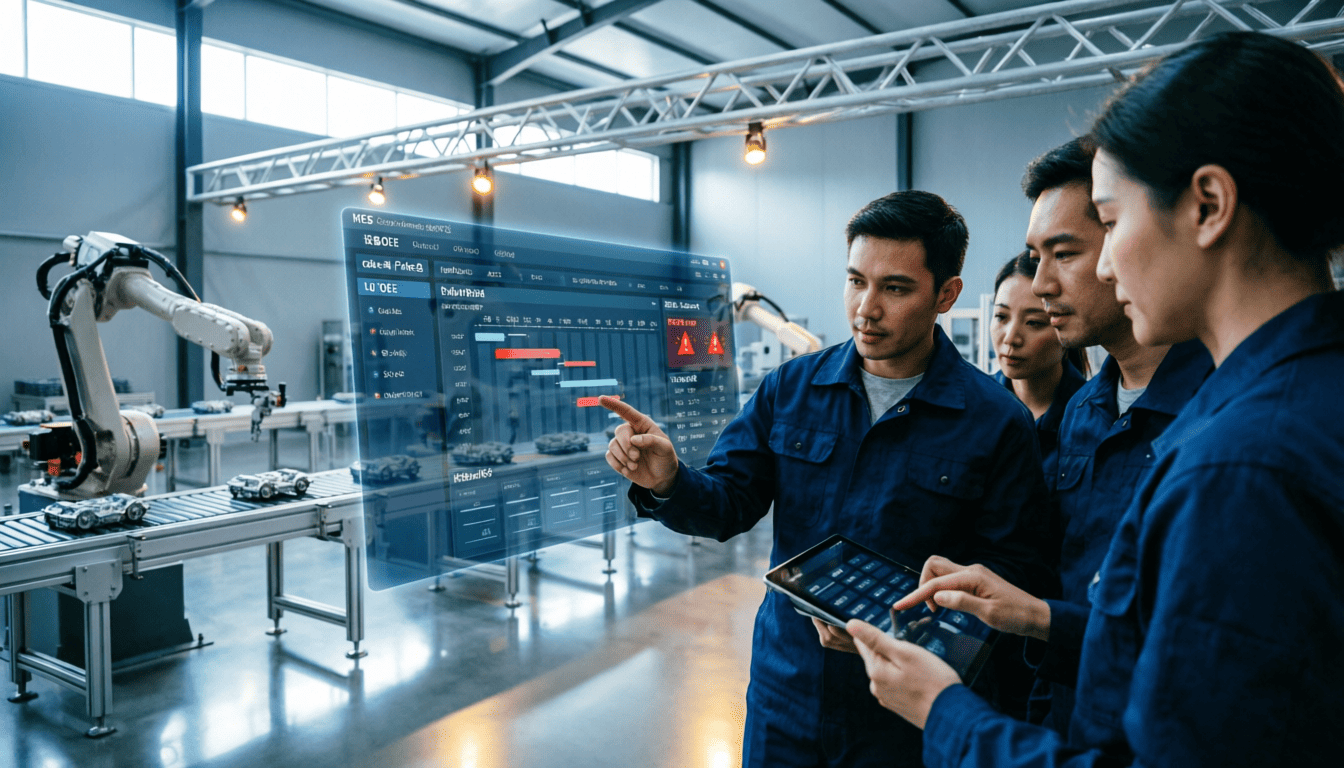
KPIs and specialized software turn detection into a precise science. By measuring cycle time by step, we create a “heat map” of slowdowns. Systems such as Warehouse Management Systems (WMS) or Manufacturing Execution Systems (MES) provide real-time visibility, crucial to act before delays accumulate.
Process mining, an advanced technique, exploits information system data to model actual flows. This method reveals invisible bottlenecks to the naked eye, such as rework loops or hidden delays. To structure root cause analysis, Ishikawa diagram helps organize human, material and methodological factors.
Warning signs not to be ignored
The first signs of a bottleneck are often obvious :
- A backlog of inventory or pending tasks before a specific stage.
- From abnormally long waiting times for the next step.
- Downstream teams frequently inactive, waiting for work.
- Constant work overload and stress for a particular position or department.
- A jerky workflow, instead of being fluid and continuous.
Ignoring these signals is costly: customer delays, extra costs, and lower morale. Real-time monitoring systems, such as MES dashboards or IoT sensors, can catch these alerts early, avoiding major impacts on productivity.
Strategies and solutions for solving a logistics bottleneck
Reallocate resources and manage workloads
When faced with a bottleneck, prioritize the continuity of the critical process. An under-utilized system wastes its limited capacity. Assign additional staff to the bottleneck, or outsource certain tasks to a logistics provider (3PL). This approach frees up internal resources while maintaining a high level of efficiency. smooth production flow. For example, a 3PL can handle packaging or customer returns, allowing the company to concentrate on its core business. Plan longer lead times to smooth out peaks in activity and avoid overloads. Finally, ensure optimum quality of deliverables upstream: imperfect work at the bottleneck leads to unnecessary corrections, amplifying the delay. Training teams to detect bottlenecks early is an essential preventive practice.
Increasing capacity through technology and automation
Technology tools transform bottlenecks into productivity levers. A Warehouse Management System (WMS) streamlines sorting and storage, while a Yard Management System (YMS) optimizes dock and vehicle management. The integration of an ERP and a Manufacturing Execution System (MES) provides complete visibility of flows, reducing information silos. For example, ERP-MES integration synchronizes customer orders with production, eliminating the delays associated with manual coordination. By combining these tools with IoT sensors, companies can monitor equipment status and stock availability in real time. Automating repetitive tasks (planning software, robotized equipment) frees up manpower for higher value-added activities, while reducing human error.
Comparative table of solutions by neck type
| Spout type | Common causes | Technology Solutions | Organizational Solutions |
|---|---|---|---|
| Sourcing | Single supplier, long lead times, stock-outs | Supplier management platform, sourcing software | Partnership contracts, safety stock, supplier diversification |
| Production/Warehouse | Slow machine, manual process, overload | MES, automation, WMS | Kanban method, cross-training, batch management |
| Distribution/Transport | Dock congestion, lack of carriers | YMS, TMS, IoT tracking | Appointments for docks, tour planning |
This table summarizes the key solutions for three common types of bottleneck. For example, a supply bottleneck linked to single suppliers can be mitigated by diversifying partners (organization) and using a WMS (technology). In production, automating lines reduces dependence on manual processes. In distribution, managing docks via a YMS avoids logistical conflicts. Aligning technical solutions and organizational methods is essential for a lasting resolution. Continuous monitoring of key indicators (utilization rate, waiting time) helps to anticipate new bottlenecks.
Anticipating to avoid suffering: towards resilient logistics
The benefits of proactive bottleneck management
Eliminating logistical bottlenecks means more than just boosting productivity. The positive impacts reverberate throughout the value chain.
- Increase in overall productivity A smooth logistics flow means more units can be processed in less time, maximizing system throughput.
- Improving relations On-time deliveries boost customer confidence, while a predictable flow simplifies interactions with suppliers.
- Cost reduction Fewer delays avoid contractual penalties, and optimal inventory management reduces unnecessary storage costs.
- Employee well-being : Teams less stressed by repetitive emergencies gain in commitment and efficiency.
Continuous improvement as a corporate culture
Bottlenecks obey a simple principle: solving one often reveals another. Eliyahu Goldratt's Theory of Constraints (TOC) postulates that optimization is an infinite cycle. Each improvement shifts the constraint, requiring constant vigilance.
To integrate this approach into the company's DNA, two methodological frameworks are essential the Lean Management philosophy and the PDCA cycle. The first targets the elimination of waste, while the second establishes a structured improvement process (Plan-Do-Check-Act).
Adopting these approaches transforms logistics challenges into opportunities. With SXE Consulting, an expert partner in international industrial performance, companies can turn constraints into levers. By combining technical expertise and proven methodologies, logistics becomes a strategic pillar, no longer a hindrance.
Logistics resilience is not achieved by a single solution, but by a culture of anticipation. By integrating these principles, every link in the chain gains in agility, preparing the company for meeting future challenges with agility.
Controlling logistical bottlenecks is essential for optimize productivity and reduce costs. A proactive approach, based on the philosophy of Lean Management and the PDCA cycle, enables you to anticipate bottlenecks and anchor your company's success. a culture of continuous improvement. By transforming these challenges into opportunities, companies strengthen their resilience and competitiveness, with SXE Consulting as strategic partner.