Does industry seem to you a challenge to understand between its Latin roots (“industria”, evoking know-how and invention) and its modern revolutions? Decipher its essence From prehistoric times, when the lithic industry forged tools, to Industry 4.0, which combines artificial intelligence and robotics. This guide explores the industry's pillars - consumer goods, equipment and intermediates - its environmental challenges and its digital transformations, while addressing CSR issues. Discover how it is shaping our society, from steelmaking to biotechnology, from fossil fuels to automated processes, while distinguishing between industry and the companies that work in it.
- What is industry: definition and etymology
- The historical evolution of industry: from origins to revolutions
- The fundamental characteristics and processes of industrial activity
- Industry classifications and key sectors
- Industry 4.0 and the trends of the future
- Impacts, challenges and industry responsibility
- Industry vs. business: an essential distinction
What is industry: definition and etymology
The fundamental definition of industry
Industry encompasses economic activities transforming raw materials into material goods, It's an industry that produces goods and services, thanks to energy sources such as coal, electricity and renewable energies. Unlike agriculture or services, it produces tangible objects in the secondary sector. For example, the agri-food industry converts organic products into food via standardized processes (pasteurization, packaging), while the iron and steel industry transforms iron ore into steel for the construction and automotive industries.
The etymological origins and evolution of the term
Derived from the Latin industria («know-how»), the word was used in the 18th century to designate any productive activity. In the 19th century, with the Industrial Revolution, agriculture was separated from it. This marked the rise of mechanized production, exemplified by Watt's steam engine (1769) and mechanical looms (1786), which revolutionized the world economy. Industry becomes synonymous with factories and mass production and new social structures such as the working class.
Distinction from crafts: the first signs of industrialization
In contrast to craftsmanship, industry relies on the division of labor and machines, enabling mass production. While craftsmanship valued uniqueness, industry sought standardization. The example of the Ford factories, which pioneered assembly-line production in 1913, embodies the logic of modern production. In contrast to craft workshops, industry rationalizes processes in order to maximize efficiency, reduce costs and meet growing national and international demand.
The historical evolution of industry: from origins to revolutions
The beginnings of industrial activity: from prehistory to the Middle Ages
Industry was born with the first traces of human ingenuity. As early as prehistoric times, the lithic industry revolutionized survival through the creation of carved stone tools, while pottery and metallurgy marked a turning point in the development of the human body. major technological leaps. In the Middle Ages, water and windmills mechanized agricultural tasks, and the cloth industry (such as Flanders fabrics) became an economic mainstay, foreshadowing future trade networks.
The great industrial revolutions: drivers of transformation
Industrial revolutions redefine the scale and logic of production. The first revolution (1790) relied on steam and coal, enabling machines such as Stephenson's locomotive (1829). The second revolution (1850) relied on electricity (Edison's light bulb, 1879) and steel production via the Bessemer process, essential for railroads and buildings. Fordism (Taylor + Ford) imposed a radical division of labor, increasing the productivity of the Model T by a factor of 10. These upheavals triggered rapid urbanization and workers' struggles, leading to the emergence of trade unions.
To find out more about these breakthroughs, explore the industrial revolutions, that have shaped modern society, from factories to unions.
The 20th century and the era of industrial diversification
The 20th century accelerates transformation with fossil fuels (oil, gas), a mobile energy source for automobiles and aviation. Electronics (transistors, 1947) and computing (ENIAC computers, 1946) automated processes, while nuclear physics paved the way for energy production and medical applications (radiotherapy). Biotechnology (recombinant DNA, 1970) revolutionized health and agri-food, with innovations such as aspirin and artificial silk.
This era paves the way for Industry 4.0, integrating AI (optimization algorithms), Big Data (real-time supply chain analysis) and connected objects (predictive maintenance). The factories of the future combine these technologies for a unprecedented productivity.
The fundamental characteristics and processes of industrial activity
Production principles: mechanization, automation and rationalization
Modern industry is based on mechanized and automated processes. Mechanization uses machines to replace manual tasks, while automation integrates computerized systems to reduce human intervention. These advances enable mass production, generating economies of scale. Process rationalization optimizes every stage of manufacturing, limiting waste and increasing efficiency. These principles, inherited from the industrial revolutions, now rely on the Internet of Things (IoT) for real-time adjustments, such as predictive analysis of machine breakdowns.
Key functions within the industrial company
Industrial organization is based on interconnected functions, essential to performance. These functions include :
- Design : Product development with tools such as 3D modeling, integrating sustainability constraints
- Production : Manufacturing goods with robotized lines, ensuring precision and repeatability
- Logistics : Flow management via connected traceability systems, such as RFID tags
- Company management Strategic steering with real-time planning tools, integrating IoT data
- Human resources : Recruitment of specialized profiles and digital training for technological skills
- Safety : Protection via predictive detection systems, such as vibration sensors
- Risk management Anticipation through scenario modeling, integrating big data analysis
- Quality: Control with in-line sensors, enabling immediate corrections
- Accounting: Financial monitoring in real time, coupled with industrial performance indicators
- Intellectual property Protection through patents and technical know-how, accelerating innovation
These processes are part of the industrial engineering, a discipline that optimizes overall performance. These functions, combined with intellectual property, form a structured ecosystem, key to the international competitiveness of industrial organizations.
Industry classifications and key sectors
Industry's position in economic sectors
Industry is mainly in the secondary sector, dedicated to the transformation of raw materials into manufactured goods. Some branches, such as the extraction industry (mining, quarrying), are included in the primary sector because of their link with resource exploitation. This distinction reflects the diversity of processes, from basic transformation to complex operations requiring specialized equipment. It allows us to’analyze sectoral contributions to the economy and guide public policies, as investment in digital transformation.
The different industrial typologies
Different industries by the destination of their products. Consumer goods (food, textiles) meet the direct needs of households. Capital goods (automotive, aerospace) supply machinery to other sectors. Intermediate goods (steel, chemicals) produce semi-finished products for industrial sectors. We also distinguish between heavy industry (steel, petrochemicals), which is capital-intensive and regulated, and light industry (electronics, textiles), with its reduced environmental impact and rapid cycles. These distinctions influence digital transformation strategies and risk management.
| Classification type | Examples of sectors | Description |
|---|---|---|
| By product destination | Consumer goods | Production of products directly usable by the end consumer (e.g. textiles, agri-food). |
| Capital goods | Manufacture of machines and tools for other industries (e.g. automotive, mechanical engineering). | |
| Intermediate goods | Transformation of raw materials into semi-finished products for other industries (e.g. iron and steel, chemicals). | |
| By economic sector | Secondary sector | Transformation of raw materials into manufactured products. |
| Primary sector (partial) | Extractive industries (e.g. mining). |
Industry 4.0 and the trends of the future
Definition and challenges of Industry 4.0
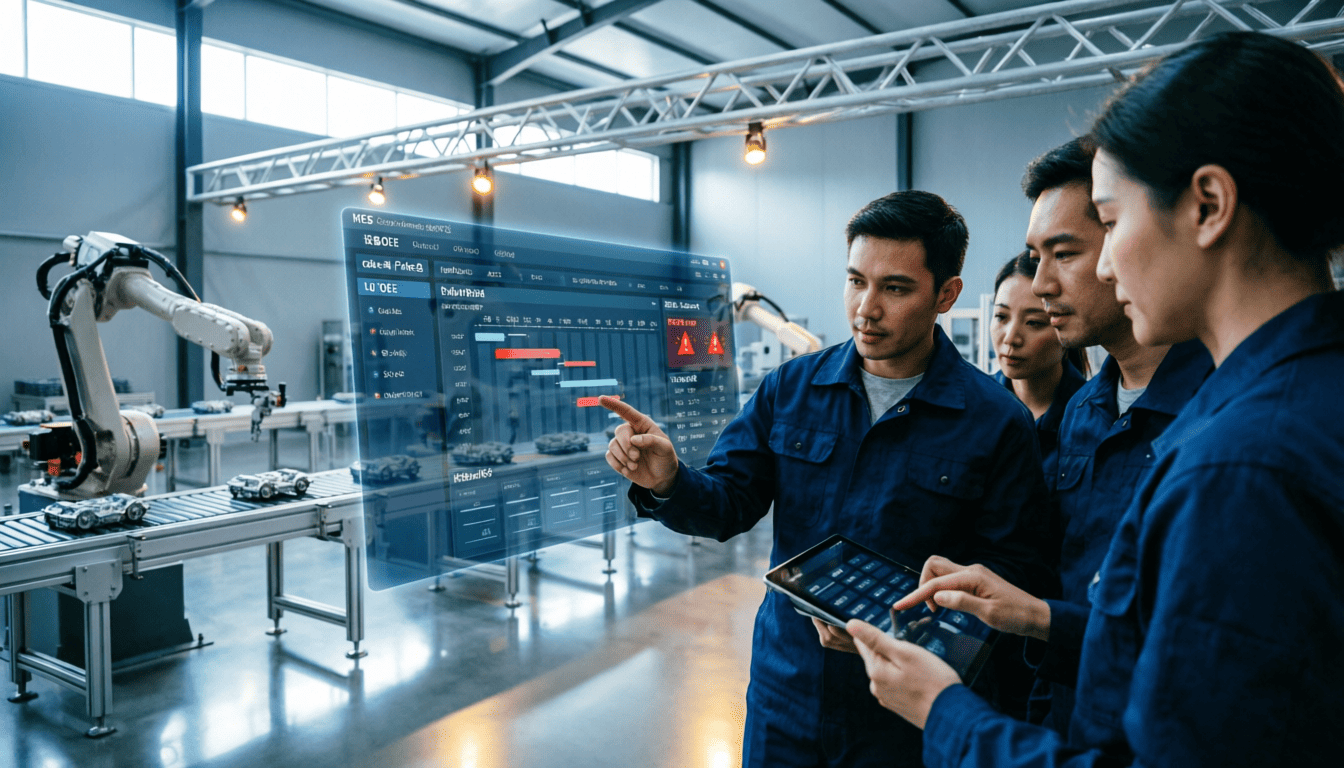
Industry 4.0 embodies the fourth industrial revolution, marked by the fusion of digital technologies and physical systems. It is based on connected networks, real-time data and intelligent automation. The goal? To revolutionize manufacturing processes for optimal industrial performance, greater responsiveness and lower costs. This digital transformation is redefining production engineering standards on an international scale.
Key technologies for industrial performance
This paradigm is based on disruptive innovations :
- Artificial Intelligence (AI) Predictive analysis for maintenance and optimization of logistics flows.
- Industrial Internet of Things (IIoT) : Connected sensors for real-time equipment monitoring.
- Big Data : Use data to anticipate supply chain needs.
- Cloud Computing Data centralization for fluid process management.
- Cybersecurity Protecting critical systems against cyberthreats.
- Additive Manufacturing Customized production and reduced inventory thanks to 3D printing.
- Collaborative robotics : Cobots for safety and productivity on the shop floor.
- Digital twins Virtual modeling to test risk-free scenarios.
Impact on processes and the value chain
These technologies are radically transforming operations. Predictive maintenance is reducing unplanned 30% stoppages at some manufacturers. Real-time traceability improves supply chain management, a critical issue for international companies. Thanks to the cloud, teams collaborate in a continuous flow, from design to delivery. For process optimization experts, Industry 4.0 combines Lean Management and digitalization, as explained in our Lean & Industrie 4.0 approach or the synergy with Lean Management.
The gains are tangible: +20% in throughput in the food industry thanks to automation, -26% in energy consumption in the steel industry. These advances position manufacturers to meet future challenges, from sustainability to economic resilience.
Impacts, challenges and industry responsibility
Resource consumption and environmental impact
Industry, by its very nature, mobilizes 60 % of the world's natural resources and generates major ecological pressures. Its intensive use of energy, water and raw materials generates more than 55 % of greenhouse gas emissions, and disrupts local balances through soil, river and air pollution. The scarcity of resources, with fossil reserves estimated at 140 years for coal, raises questions about the sustainability of current models. The industry must therefore reinventing processes to avoid compromising the future.
Sustainable development and corporate social responsibility (CSR)
To meet these challenges, sustainable development and CSR strategies are becoming increasingly widespread. The aim is threefold: to reduce the ecological footprint, integrate ethical practices and reinforce positive social impact. In France, companies such as Hoffman Green (low-carbon cement) and Pocheco (eco-friendly envelope manufacturing) are leading the way. The United Nations' MDG 9 calls for industries to modernize for sustainable growth, with a focus on innovation and reducing global resource-related emissions by 40 % by 2030. Green industry is thus becoming an essential lever for reconciling performance and responsibility.
Industry vs. business: an essential distinction
Clarifying notions: a sector of activity versus an economic entity
Industry refers to a sector of economic activity centered on the transformation of raw materials into material goods through the use of energy. It is mainly in the secondary sector, including manufacturing, mass production and process rationalization.
Conversely, a company is a an independent economic entity that can operate in a variety of fields. It can operate not only in industry, but also in trade, services and other sectors, without being limited to material production.
The company: a player within the industry
An industrial company embodies the activity of a specific sector. A car plant like Renault, for example, embodies a company operating in the automotive industry. This distinction reminds us that a can cover several areas, The industry remains limited to material production.
Understanding this difference is the key to understanding the economic structure: industry is one of the world's most important industries. pillar of the economy, The company is the concrete actor, multiplying the interfaces between theory and practice.
Industry, a pillar of the global economy, has evolved from artisanal revolutions to Industry 4.0, combining mechanization and digital technologies. Transforming resources into essential goods, it must reconciling growth and sustainability, integrating CSR and innovation. Distinct from the concept of enterprise, this sector remains central to material production, These are the milestones of our economic history and the challenges of the future.