It's hard to understand how communication interfaces transform incompatible systems into coherent networks ? Discover how these technical tools ensure signal translation, exchange reliability and data management in complex environments. Whether for basic analog sensors, industrial protocols such as CAN, ultra-fast Ethernet networks or universal standards such as USB, this article examines the key mechanisms and selection criteria - throughput, distance, security - for optimizing interoperability and anticipating the challenges of digital transformation and cybersecurity in Industry 4.0.
- Understanding the communication interface: a cornerstone of information exchange
- The fundamental role of the interface in data exchange
- The main families of technical communication interfaces
- Comparison of current technical interfaces and their relevance
- The impact of communication interfaces on industrial performance
- Beyond technology: the human communication interface
- Future prospects and challenges for communication interfaces
Understanding the communication interface: a cornerstone of information exchange
Imagine a world where systems couldn't exchange information. Connected objects, industrial machines or household appliances would remain isolated, unable to collaborate. Communication interfaces make these exchanges possible, playing a key role in our daily lives, especially in industry, where they synchronize complex processes on an international scale.
What is a communication interface?
A communication interface acts as a bridge between two systems or components. It defines the rules and formats that enable these entities to exchange data. Without them, each system would remain locked in its own logic. They ensure compatibility between different technologies, It's like a common language between speakers of different dialects, linking ancient systems with modern technologies. A vintage machine can thus be integrated into a modern industrial network via an adapted interface.
Why are they essential in today's world?
From smartphones to smart factories, communication interfaces are everywhere. They collect data in real time, automate complex processes and support informed decision-making. Their reliability is crucial A breakdown can paralyze a production line or essential services. They have evolved in response to technological challenges, integrating modern solutions based on Ethernet or secure protocols, while sometimes retaining older interfaces for their simplicity. This flexibility meets the varied needs of every sector, from industry to healthcare.
Their impact goes beyond machines: they also facilitate global collaboration. In a company, a well-designed interface links sites around the world, ensuring smooth coordination. They become a a strategic lever for digital transformation, harmonizing previously fragmented operations.
The fundamental role of the interface in data exchange
Facilitate interoperability between heterogeneous systems
Communication interfaces act as universal intermediaries, enabling systems with different languages or structures to work together exchange information. They ensure seamless translation of data, whether converting analog signals to digital or standardizing file formats. For example, a production management system and a process optimization tool can communicate via a standardized interface, even if they come from different suppliers.
Their role is strategic in international supply chains, where equipment from different manufacturers has to cooperate. A Luxembourg-based company specializing in industrial performance uses these interfaces to connect project management tools to digital transformation systems, despite their initially incompatible designs. This ensures smooth coordination between distant production sites, reducing friction in global operations.
Ensure the reliability and integrity of information
In critical environments such as industrial production, interfaces incorporate permanent verification systems. They detect data corruption and correct errors before they affect processes. This prevents costly breakdowns or decisions based on corrupted information, especially in sectors such as industrial refractories, where precision is vital.
- Standardization of protocols for universal understanding.
- Signal conversion (analog to digital and vice versa).
- Data flow management to avoid overloading.
- Error detection and correction for guarantee integrity.
These mechanisms are essential for securing operations on a global scale. Data flow management, for example, prevents overloads in industrial networks, avoiding delays in the transmission of critical information between remote sites. Thanks to this, companies can maintain optimum synchronization, even in the face of the challenges of industrial digital transformation.
The main families of technical communication interfaces
Analog interfaces: the basis of continuous signals
Analog interfaces use continuous signals, such as voltages or currents, to represent physical quantities. They remain relevant for applications where the simplicity over precision. Their operation is based on the transmission of variations proportional to physical measurements, suitable for basic controls.
Serial interfaces: robustness and point-to-point or multi-point communication
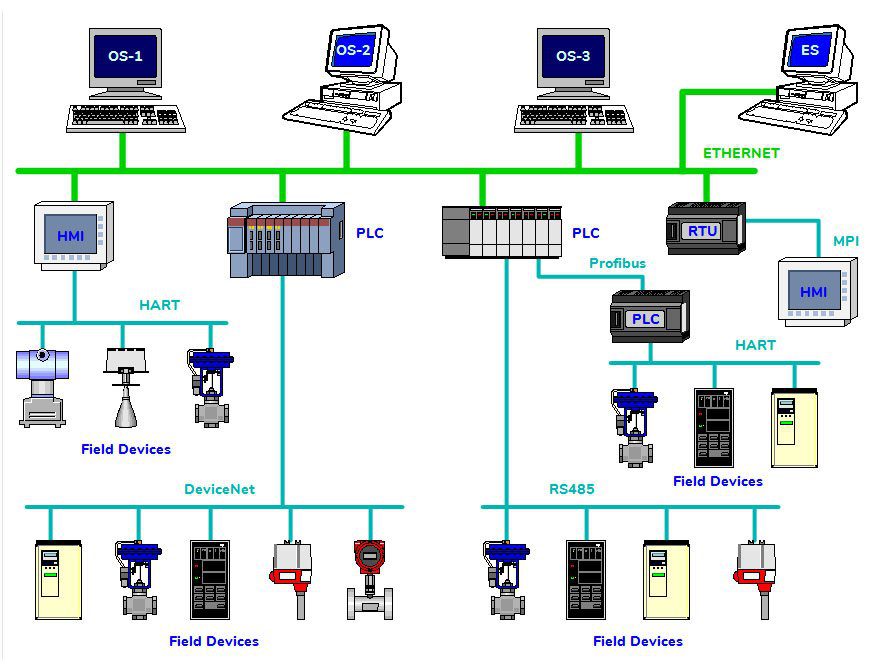
Serial interfaces transmit data bit by bit, ensuring reliable communication over long distances. The historic RS-232 is dedicated to peripherals, while the more noise-resistant RS-485/422 is the preferred choice for industrial environments. Their design enables stable transmission, even under demanding conditions.
Fieldbus and industrial protocols: at the heart of automation
Designed for connecting industrial equipment, These buses provide real-time control. Modbus, used in serial or Ethernet mode, and CAN, popular in the automotive industry, illustrate their versatility. PROFIBUS, meanwhile, is a standard for factory automation, guaranteeing reliable exchanges between sensors and actuators.
Ethernet-based interfaces: speed and flexibility
Industrial Ethernet enables high-speed data transfer for large data volumes. Protocols such as EtherCAT (low latency), Ethernet/IP (easy integration) or PROFINET (evolution of PROFIBUS) make it a strategic choice for modern networks. These technologies optimize industrial supervision, as explained in our article on HMI/SCADA integration.
USB: the universal interface for configuration and transfer
USB is establishing itself as a versatile interface for connecting peripherals to computers. In mechatronics, it is used for configuration and ad hoc data transfer, replacing older serial interfaces. Its simplicity and speed make it a the essential standard for consumer and industrial applications.
Comparison of current technical interfaces and their relevance
Choosing the right interface for each application
The choice of interface depends on throughput, distance, noise immunity, cost and compatibility. For example, analog is suitable for simple applications, while EtherCAT is preferred for industrial synchronization.
Comparative table of the main technical interfaces
| Interface type | Key features | Key benefits | Typical applications |
|---|---|---|---|
| Analog | Continuous signals, low complexity. | Simple, cost-effective. | Simple sensors, basic feedback. |
| RS-485/RS-422 | Series, robust, multi-point. | Noise immunity, long distances. | Industrial environments, building control. |
| Modbus (RTU/TCP) | Simple, standardized serial or Ethernet protocol. | Broad support, easy integration. | Industrial automation, exchange between devices. |
| CAN | Serial, robust, multi-point, real-time. | Reliability, on-board efficiency. | Automotive, mechatronics, real-time control. |
| Ethernet (general) | Local, high-speed, flexible network. | High speeds, extensive connectivity. | Enterprise networks, device integration. |
| EtherCAT / PROFINET | Ethernet-based, real-time, high-performance. | Low latency, high speed. | Advanced automation, smart factories. |
| USB | Serial, point-to-point, plug-and-play. | Ease of use, versatility. | Connect peripherals, configure. |
There is no universal solution: each interface meets specific needs. CAN is the standard for automotive applications, while EtherCAT is indispensable for complex automation.
The impact of communication interfaces on industrial performance
Process optimization and advanced automation
Modern communication interfaces are strategic levers for production line efficiency. Their choice is crucial for real-time data collection, essential for automation and supervision. Solutions such as Modbus or EtherCAT synchronize equipment with minimal latency, significantly reducing downtime thanks to smooth transmission of commands and feedback.
By integrating these protocols, industrial systems avoid bottlenecks. This fluidity preserves product quality while minimizing rejects, even in the event of load variations, ensuring critical operational stability for demanding sectors.
Switching to serial networks (e.g. Profibus) reduces wiring costs from 30 to 50% compared with parallel architectures. This simplification makes it easier to install, maintain and update production lines, while freeing up physical space for future upgrades.
Contributing to industrial digital transformation
Interfaces act as gateways to the Industrial Internet of Things (IIoT). They connect equipment to IT systems, enabling the analysis of megadata to anticipate breakdowns or optimize processes. This data feeds predictive models, improving maintenance and industrial planning.
Industrial Ethernet (e.g. PROFINET) becomes the reference standard, offering data rates of up to 100 Gbps. This evolution facilitates the vertical integration of data, from the machine to the decision-making system, while supporting complementary technologies for enhanced security.
Leadership is key to the success of this digital transformation. As explained in the impact of leadership on industrial digital transformation, Technical challenges require a strategic vision aligned with business objectives, and support for teams, particularly in the choice of protocols and operator training.
Beyond technology: the human communication interface
A role of mediation and adaptation
A communication interface can refer to a professional who facilitates exchanges between deaf/hard-of-hearing and hearing people. This mediator uses various tools such as LSF (Langue des Signes Française), LfPC (Langue Française Parlée Complétée) or the written word to ensure mutual understanding and promote inclusion.
- Facilitating comprehension between individuals.
- Use of various communication modes (LSF, LfPC, written).
- Supporting independence and inclusion.
These professionals adapt their approach to the context, whether for cultural events, administrative procedures or everyday interactions. Their role goes beyond simple translation: they integrate cultural and linguistic nuances in order to streamline communication, particularly for people with associated disabilities.
Future prospects and challenges for communication interfaces
Towards ever more intelligent and secure interfaces
Communication interfaces integrate AI to create autonomous systems, capable of adapting to environmental variations in real time. This evolution makes more responsive and efficient mechatronic systems.
Yet cybersecurity remains a challenge. Legacy protocols often lack security mechanisms, exposing industrial networks to risks. Solutions such as firewalls and intrusion detection systems can help. are needed to reinforce protection.
Data interoperability is one of the pillars of our business. It enables fluid exchange between heterogeneous systems, reducing costs and improving productivity. Open standards and modular architectures facilitate this integration, which is crucial for Industry 4.0.
A strategic lever for industrial innovation
For companies, high-performance interfaces are a competitive advantage. They modernize processes, optimize predictive maintenance and meet market expectations.
Human-machine interfaces (HMIs) become intuitive, integrating voice recognition and adaptive interfaces. They simplify the user experience and reinforce safety right from the design stage, essential for sustainable solutions.
The communication interfaces, whether technical or human, are essential for information exchange. They link systems, ensure interoperability and drive automation. In the face of digital transformation, their evolution towards greater speed, security and interoperability remains a major challenge. strategic leverage for industrial innovation and inclusion.