
What event profoundly transformed the world by replacing manual labor with steam power, paving the way for technical progress? The Industrial Revolution, that historic turning point between the 18th and 19th centuries, transformed societies by mechanizing production, concentrating populations in cities and laying the foundations of our modern era. Through decisive inventions such as the steam engine, the mule-jenny or the Bessemer process, it not only redefined the economy, but also reshaped everyday life, charting a trajectory that leads straight to Industry 4.0.
- The Industrial Revolution: defining a major historical turning point
- The origins of the Industrial Revolution: fertile ground for change
- The first industrial revolution: the age of coal and steam (c. 1760-1870)
- The second industrial revolution: the age of steel, electricity and oil (c. 1870-1914)
- Social and economic upheaval: a new face for society
- The legacy of the Industrial Revolution and its contemporary echoes
The Industrial Revolution: defining a major historical turning point
What is the Industrial Revolution?
The Industrial Revolution a shift from agrarian and artisanal societies to an industrial model and commercial. Born in the United Kingdom in the 18th century, it was based on the mechanization of production processes, centralized in factories. Steam engines, then fossil fuels, replaced manual labor. Industry became the economic epicenter, supported by transportation networks (railroads, steamships) and modernized communications. Inventions such as the steam engine, the mule-jenny and the locomotive illustrate this era of innovation, revolutionizing production and lifestyles.
A debated concept: revolution or industrialization?
The term “revolution”, popularized by Adolphe Blanqui and Friedrich Engels, is disputed. Fernand Braudel and Patrick Verley prefer the term “industrialization”, underlining a gradual process in many countries, in contrast to the British case, where the transformation was brutal. Concepts such as “proto-industrialization” (Franklin Mendels) or “industrial nebulae” (Pierre Léon) describe earlier intermediate stages. Werner Sombart evokes an older phenomenon, linked to the emergence of the Florentine bourgeoisie. Arnold Toynbee, who popularized the concept, emphasizes the complexity of a phenomenon oscillating between rupture and continuity. This nuance reminds us that industrial history blends debate and facts.
The origins of the Industrial Revolution: fertile ground for change
The agricultural and demographic revolution upstream
The agricultural revolution, marked by crop rotation (Norfolk system) and enclosures in England, doubled agricultural yields as early as the 18th century. The Enclosure Acts of 1727 consolidated plots, increasing productivity, but also expelled hundreds of small farmers, fueling a massive rural exodus.
Europe's population grew from 140 to 180 million between 1750 and 1800. This demographic growth fuelled both an economic abundant manpower for factories and an expanded market for manufactured goods. Industrial cities such as Manchester and Liège saw their populations quintuple in just a few decades.
A buoyant socio-economic and ideological context
The rise of the industrial bourgeoisie, imbued with capitalist values (savings, reinvestment), was decisive. Inspired by Max Weber's Protestant ethic, this class valued hard work and discipline, fundamental to the emergence of industrial capitalism.
The d'Allarde decree of 1791 in France abolished guilds, establishing freedom of trade. Inspired by physiocrats such as Turgot, this reform stimulated competition and investment. Public limited companies made it possible to raise capital to finance the colossal costs of plant and machinery.
Early innovations and energy management
James Watt's steam engine (1769/1771) transformed the thermal energy of coal into mechanical work, enabling continuous production. This breakthrough made factories independent of human or hydraulic power, like watermills.
Key factors in the revolution :
- Agricultural progress freeing up manpower (enclosures, Norfolk system)
- Rise of capitalism and entrepreneurship (Protestantism, Allarde decree)
- Legal framework conducive to free enterprise (abolition of corporations)
- Access to coal and iron (70% of industrial energy in 1850) and iron (doubled in England)
- Technical innovations like the mule-jenny (1779) and the locomotive (1825)
The combination of these factors created the ideal conditions for large-scale mechanization, marking the beginning of a new era of mechanization. the start of the industrial era. Cities were covered with factories, while industrial productivity soared, with British GDP tripling between 1750 and 1850.
The first industrial revolution: the age of coal and steam (c. 1760-1870)
The UK, cradle of industrialization
What factors behind the British lead ? England had coal reserves located less than 300 km from major manufacturing centers, reducing transport costs. The banking system, with the Bank of England (1694), made it possible to mobilize capital on a large scale, while profits from the colonies fueled industrial investment.
Agriculture, revolutionized by enclosures, saw productivity triple between 1700 and 1800. This modernization forced 15 % of the rural population to migrate to the cities in search of work, forming a working-class proletariat. Liberal ideas, as expressed by Adam Smith in “The Wealth of Nations” (1776), encouraged competition and technological innovation.
Key sectors: textiles, steel and transport
Why did British textiles dominate? The jenny mule (1779) enabled yarn to be produced 120 times faster, while Cartwright's power loom (1785) doubled weaving productivity. By 1850, 60 % of textile workers worked in mechanized mills.
The iron and steel industry benefited from Cort's puddling process (1784), which increased annual production of beaten iron by a factor of 50. Railroads, with Stephenson's 48 km/h “Rocket” (1829), revolutionized transport. By 1850, the British network comprised 10,000 km of lines, stimulating demand for iron rails (1 tonne of iron for 100m of rail).
Distribution in continental Europe and its specific features
How did France adapt the model? Despite an initial delay, the development of canals (Canal du Midi completed in 1681) facilitated the transport of raw materials. In 1794, the French government created the École des Mines to train engineers, and railways have exploded after 1842, reaching 1,500 km in 1850 compared with 100 in 1830.
In Belgium, 80 % of rail investment came from private capital, compared with 30 % in France. The Cockerill steelworks in Seraing adopted the Bessemer converter (1855) as early as 1860, enabling them to produce 50 tons of steel in 20 minutes, compared with 12 hours previously. This technical advance explains why Belgium became the continent's leading steel producer in 1870.
The second industrial revolution: the age of steel, electricity and oil (c. 1870-1914)
New energies, new materials, new industries
The second industrial revolution marked a turning point thanks to electricity and oil. Electricity, made accessible by Zenobe Gramme's dynamo in 1871, revolutionized factories and homes. Oil, exploited with modernized techniques, became a strategic resource for internal combustion engines.
Steel, mass-produced using the Bessemer process (1855), replaced iron. Stronger and lighter, it enabled bold constructions such as bridges and railroad lines. Heavy steelmaking and chemicals become key sectors, This led to innovations such as synthetic dyes and chemical fertilizers.
The emergence of new global powers
| Features | First Industrial Revolution (c. 1760-1870) | Second Industrial Revolution (c. 1870-1914) |
|---|---|---|
| Period | c. 1760-1870 | c. 1870-1914 |
| Dominant energies | Coal, steam | Electricity, oil, gas |
| Major innovations | Steam engine, spinning machine, locomotive | Internal combustion engine, dynamo, telephone, light bulb |
| Key materials | Iron, cast iron | Steel, aluminum, chemicals |
| Driving sectors | Textiles, steel, railroads | Chemicals, automotive, heavy steel |
| Leading countries | United Kingdom, France, Belgium | United States, Germany, Japan |
| Work organization | The beginning of the division of labor | Taylorism, Fordism (assembly line work) |
The global balance shifts with the rise of the United States and Germany, overtaking the United Kingdom. These nations dominated thanks to the electrification of factories, mass production of automobiles (Ford Model T, 1908) and technological innovation (telephone in 1876, light bulb in 1882). After the Meiji Restoration (1868), Japan established itself as an industrial power in Asia.
This period redefined the global economy. Electricity and steel enabled intensive industrialization, while oil paved the way for modern transport. Production methods such as Taylorism increased productivity, but also deepened social and environmental inequalities. The consequences of this revolution still structure the global economy today.
Social and economic upheaval: a new face for society
The emergence of new social classes
The industrial revolution reshaped the social pyramid. On the one hand, the industrial bourgeoisie, owners of factories and capital, became the new economic and political elite. On the other, the working proletariat, forced to sell its labor, became the majority in urban areas. This polarization has generated tensions, The “social question”.
The structural inequalities between these groups encouraged the emergence of radical doctrines. Socialism, advocating an equitable distribution of wealth, found particular resonance. Trade unions, despite their initial illegality, gradually took shape to defend workers' rights, marking a turning point in the history of the trade union movement. a turning point in the class struggle.
Massive urbanization and new living conditions
The countryside was emptied of its agricultural workforce, driven to the cities by the mechanization of fields and enclosures in England. Working-class neighborhoods grew up around the factories, with no prior urban planning. Housing, overcrowded and unhealthy, They often had no sewers or drinking water.
Workers endured 12 to 14 hours a day in noisy, dangerous workshops. Children as young as 5 years of age worked alongside deadly machines. In Manchester, life expectancy was just 28 years, with over 50 % of children dying before the age of 5. These extreme conditions triggered uprisings and progressive social reforms.
Transforming work organization
The quest for efficiency revolutionized production methods. In 1911, Frederick Taylor theorized the Scientific Organization of Work (SOW), segmenting tasks to maximize productivity. Henry Ford amplified this model in 1914 with the assembly line, enabling standardized mass production. These approaches prefigured modern methods of’process optimization with lean management.
- A unprecedented economic growth and productivity.
- A massive rural exodus and rapid urbanization.
- The emergence of new social classes the bourgeoisie and the proletariat.
- Visit development of trade unionism and socialist ideologies.
- A industrial and chemical pollution on a large scale.
These innovations increased inequality while laying the foundations for a globalized economy. The specialization of tasks, while profitable, has led to worker alienation, This is a challenge still debated today in continuous improvement strategies.
The legacy of the Industrial Revolution and its contemporary echoes
From the third to the fourth industrial revolution
The industrial revolution did not come to an abrupt halt: it continued through successive evolutions. The third revolution, which began in the 1970s, introduced electronics, information technology and automation. Today, Industry 4.0 marks an unprecedented acceleration, integrating the Internet of Things (IoT), artificial intelligence and cyber-physical networks. These technologies transform factories into intelligent systems, with real-time decision-making, flexibility and optimization capabilities.
Environmental impact: a lasting consequence
While the Industrial Revolution boosted productivity, it also ushered in an energy model dependent on fossil fuels. From the 18th century onwards, coal and then oil dominated, leading to unprecedented pollution. Today, this dependence accounts for 70 % of global CO2 emissions, with an increase of 48 % in its atmospheric concentration since 1750. Today's climate challenges - global warming of +1.2°C, melting ice caps, extreme events - are a reminder of the importance of climate change.’urgent need to rethink industrial processes towards renewable energies and a circular economy.
Continuous improvement: from yesterday's factories to today's industrial performance
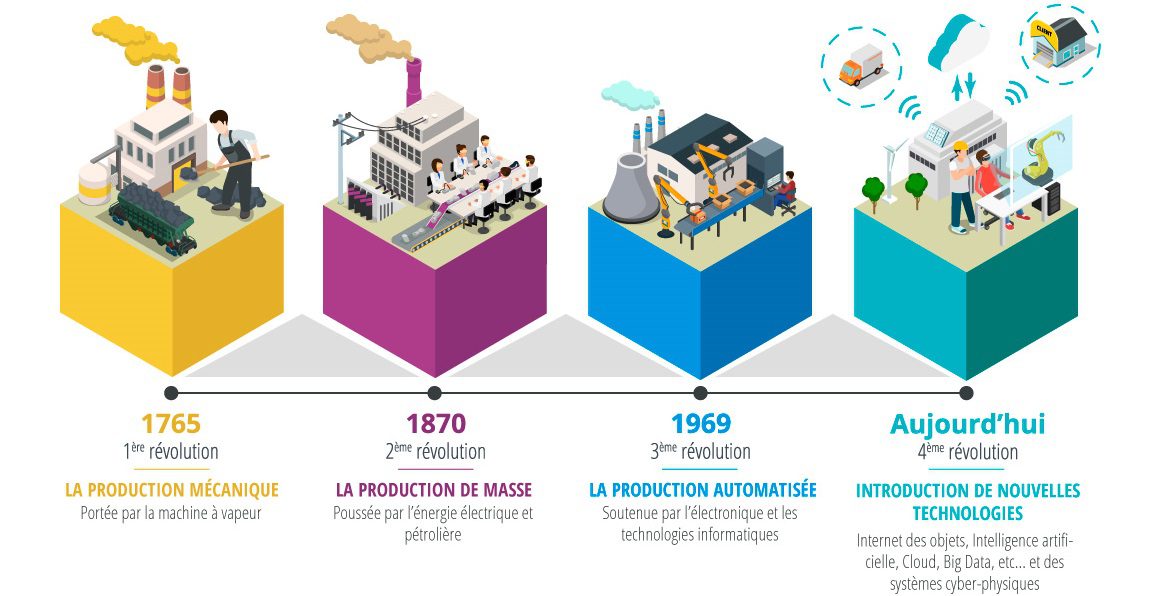
The quest for efficiency, initiated by Taylor and Ford, has evolved into structured methodologies. Lean Management, Kaizen and Industry 4.0 are all examples of this. this transition, combining optimization and innovation. Here are the key steps:
- First revolution (late 18th century) Mechanization, steam, coal.
- Second revolution (late 19th century) Mass production, electricity, oil.
- Third revolution (late 20th century) Automation, computing, electronics.
- Fourth revolution (today) Cyber-physical systems, Internet of Things, AI (Industry 4.0).
For a Luxembourg-based company specializing in industrial performance, these developments underline the importance of constant adaptation. By combining digitalization, project management and process optimization, it is anticipating tomorrow's challenges: reducing emissions, supply chain resilience and transforming business models. Properly integrated, Industry 4.0 becomes a strategic lever for reconciling productivity and sustainability. It's a challenge that only a global, international vision can meet.
The industrial revolution transformed agrarian societies into industrial economies, This era began in the United Kingdom in the 18th century. Technical innovations, the emergence of new social classes and economic mutations marked this era, whose legacy persists today with Industry 4.0 and environmental challenges, recalling the lasting impact of this human metamorphosis.