it is crucial to fully understand our clients' needs. A humorous but highly pertinent illustration shows the consequences of poor communication and ofover-engineering.
A Picture Worth a Thousand Words
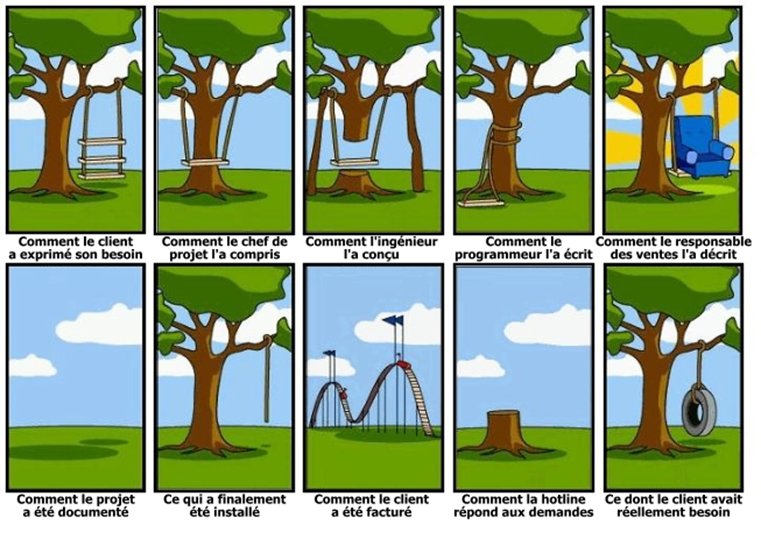
- How the customer expressed the need : A simple swing with three seats, corresponding to a clear and concise initial request.
- How the project manager understood it : A single-seat swing with badly positioned ropes, illustrating a first distortion of the initial request.
- How the engineer designed it : An asymmetrical swing with a rigid seat, showing a poor understanding of the functional needs.
- How the programmer wrote it : A simple rope tied to a branch, symbolising an excessive simplification of the project.
- How the sales manager described it : A lounge chair tied to a tree, an exaggeration intended to win over the customer.
- How the project was documented : A complete absence of documentation, a frequent problem in poorly managed projects.
- What was finally installed : A bare rope, reflecting a disastrous execution far removed from the initial need.
- How the customer was billed : A roller coaster, representing excessive and unjustified billing.
- How the hotline handles requests : A tree stump, illustrating ineffective and useless customer support.
- What the customer really needed : A simple tyre swing, demonstrating the simplicity of the unmet initial need.
Lessons to Remember to Avoid Over-Engineering
- Clear and Continuous Communication : Maintaining clear and continuous communication with the customer throughout the project is imperative. Regular checks and feedback can prevent misunderstandings.
- Accurate and Accessible Documentation : Accurate, well-organised documentation is essential. It must be accessible to all stakeholders to ensure a shared understanding of the project.
- Deep Understanding of Needs : Before starting design and development, it is crucial to fully understand the customer's real needs. This can be achieved through meetings, workshops and prototypes.
- Avoiding Over-Engineering : Adding unnecessary features or elements (over-engineering) can complicate the project, increase costs and add no value for the customer.
- Feedback and Adjustment : Integrating feedback loops and continuous adjustment are necessary to align customer expectations with project deliverables.
Conclusion : L’Importance de Comprendre les Besoins du Client
The key to success lies in a thorough and precise understanding of our customers' needs. By avoiding over-engineering and staying focused on the essentials, we can deliver effective, cost-efficient and satisfying solutions for our customers. This humorous illustration reminds us of the importance of each stage in project management and the potential consequences of poor communication and a misunderstanding of needs.
Let us keep things simple, clear and customer-focused to guarantee the success of our projects.

Xavier Schuster
Consultant at SXE Consulting. Industrial consulting firm based in Luxembourg, 25 years of experience in operational excellence.
View profile →